
Armor Crack Repair for Tennis Courts
Don’t Repave Your Court. Bridge the Cracks Permanently.
Overview
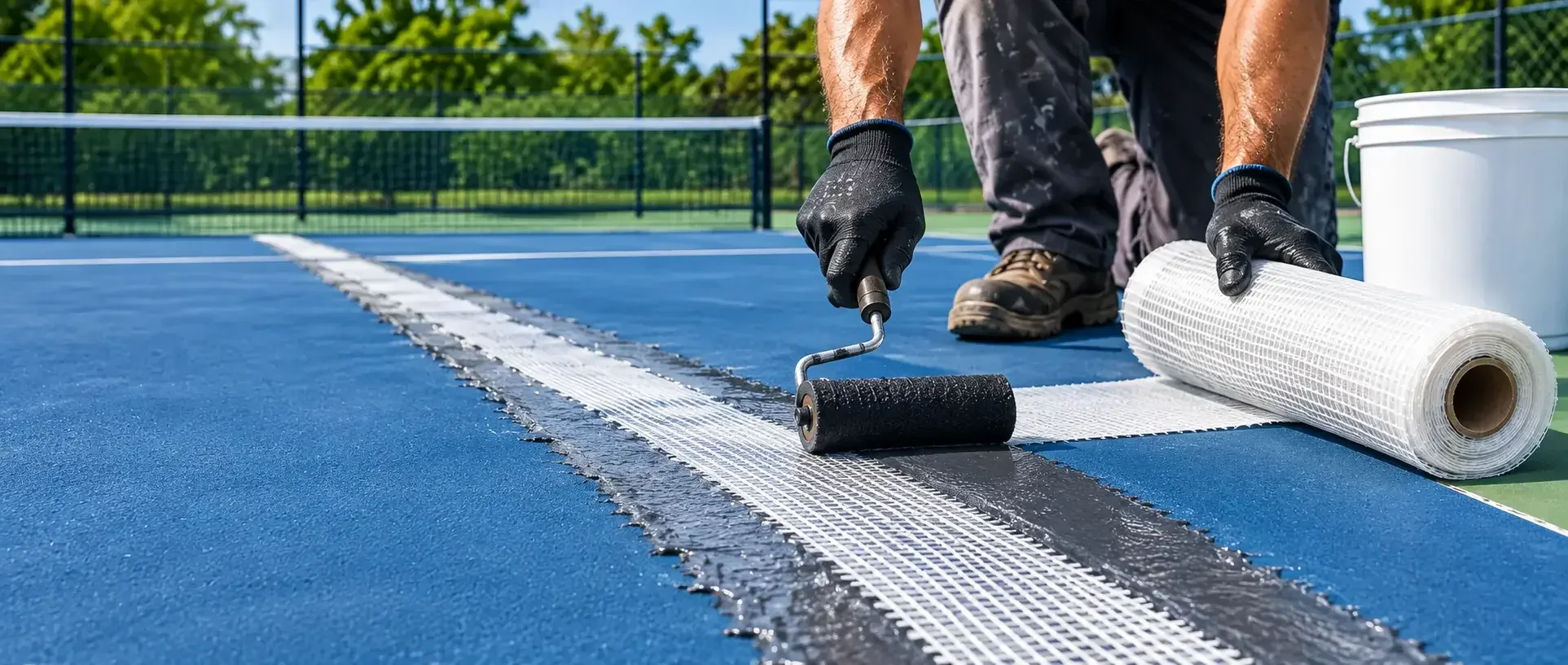
Tennis court cracks are frustrating because filling the same crack every year does not address the movement underneath it. We often see courts where a crack has already been patched two, three, or even more times, only for the same line to open again after another winter. That is where the ARMOR Crack Repair System can make sense. At Atlas Empire Group, we use ARMOR as a structural crack-repair method when the existing court is still a good candidate for resurfacing but conventional crack filling is unlikely to hold. The system uses expandable knitted fabric and a release-tape area over the crack to allow movement beneath the repair instead of forcing the surface coating to absorb all of that movement. It is not simply a thicker crack filler. The installation creates a wider reinforced repair area that is then blended into the surrounding court before the new acrylic surface is applied.
Talk to a Tennis Court Repair Expert
Not sure whether your court needs Armor crack repair, traditional crack repair, resurfacing, or a more extensive solution?
What Is the Armor Crack Repair System?
The Armor® Crack Repair System is a multi-layer repair system designed for recurring cracks in sports courts.
Its main difference from a conventional rigid crack patch is the way it handles movement.
The system uses flexible fabric layers over the crack, with the center section intentionally left unbonded. A 6-inch slip-sheet zone separates the fabric from the crack underneath, allowing the asphalt to move without transferring the same movement directly into the finished court surface.
Instead of trying to lock the two sides of a moving crack together, the repair creates a flexible bridge over the damaged area.
How the Armor System Works: The Science of the “Flexible Bridge”
A tennis court crack is not simply a hole that needs to be filled. The bigger problem is movement.
As an asphalt court ages, it becomes less flexible. Seasonal temperature changes cause the pavement to expand and contract, and an existing crack can open and close as the underlying surface moves. If a rigid material is placed directly across that moving crack, the repair has to absorb most of that movement at one narrow point. That is where the ARMOR® Crack Repair System takes a different approach.Instead of trying to lock the crack rigidly in place, ARMOR® uses expandable knitted fabric and a deliberately unbonded area over the crack. Together, these components allow the repair to absorb and distribute movement across a wider area.
-
The first part of the system is the knitted fabric.
Unlike a rigid material that has very little ability to stretch, ARMOR® uses a specially knitted fabric that can expand as the crack widens. Armor describes its fabric as behaving similarly to T-shirt material: it can stretch rather than simply tearing when the underlying crack moves.
This changes where the stress goes.
With a conventional rigid repair, movement is concentrated around the original crack line.
With the ARMOR® fabric, the movement can be distributed through a larger section of expandable material.
The crack moves → the fabric expands → the stress is distributed across the fabric instead of being concentrated at one narrow point.
-
The fabric alone isn't the whole reason how system works.
The critical detail is that the fabric is intentionally not bonded to the court directly over the crack.
ARMOR® uses a 6-inch-wide slip-sheet area over the crack. The fabric is bonded to the stable court surface outside this zone, but the center section remains unbonded.
Why does that matter?
Imagine stretching a piece of fabric while holding it tightly against a surface. If the fabric is bonded everywhere, movement underneath has very little room to redistribute.
Now give the fabric a controlled area where it can move independently.
That changes the mechanics of the repair.
-
When the crack underneath widens, the unbonded center section gives the expandable fabric room to move.
Instead of forcing all of the movement into the exact crack line, the fabric can accommodate that movement across the six-inch slip-sheet area.
Stable court ← bonded fabric ← unbonded movement zone → bonded fabric → stable court
The pavement can move underneath while the reinforced fabric bridges across the moving area.
This is why the slip-sheet is such an important part of the ARMOR® design. Armor specifically identifies the ability to spread crack stress over a six-inch-wide area of expandable fabric as a key reason the system can resist tearing and delamination.
-
ARMOR® does not rely on just one layer of fabric over the crack.
The system uses two layers of expandable fabric, along with a final mesh layer, creating a three-layer material system over the repaired crack. The completed repair is approximately 36 inches wide.
The purpose of the wider repair is important.
A narrow repair puts more stress near its outside edges. A wider reinforced area gives the movement more room to spread before it reaches the surrounding court surface.
Think of it as the difference between putting a narrow strip of material over a moving joint and creating a much wider reinforced transition between the two sides.
-
The ARMOR® repair extends approximately 36 inches across the crack.
That wider footprint gives the expandable fabric a larger area over which to distribute movement from the underlying pavement. ARMOR®'s manufacturer specifically identifies the 36-inch repair width as one of the distinguishing characteristics of its system.
The goal isn't to stop the asphalt from moving.
The goal is to keep that movement from being concentrated directly beneath the finished court surface.
That is the difference between fighting the pavement's natural movement and designing the repair around it.
The Complete Installation & Insulation Process
The Armor System is not a DIY product or a simple "pour-and-go" solution. It requires a meticulous, multi-tiered deployment process executed by certified professionals. If a single step is rushed, the structural membrane will fail.
Here is the exact step-by-step process we execute on your court:
Step 1: Deep Clean & Vegetation Sterilization
We pressure wash and route out the existing cracks. All dirt, loose debris, and roots are mechanically removed. We treat the deep void with industrial-grade vegetation killer to prevent future weed growth from puncturing the repair from underneath.
Step 2: The Core Insulation & Leveling Fill
Before any fabric is laid down, the deep structural chasm must be filled and insulated. We use a heavy-duty acrylic court patch binder mixed with fine silica sand. This is troweled deep into the crack, leveled perfectly flush with the surrounding asphalt, and left to completely cure. This provides a solid base so the fabric doesn’t sink over time.
Step 3: Aligning the "Slip-Sheet" Release Tape
This is where the magic happens. We apply a specialized 6-inch wide release tape (the slip-sheet) directly over the center of the filled crack. This tape prevents the top fabric layers from sticking to the crack itself. Because it is unbonded in this 6-inch zone, the asphalt can pull apart or expand fractions of an inch underneath during freezing weather, while the fabric stretching above safely protects the paint layer from tearing.
Step 4: The Base Adhesive & First Fabric Layer
We apply a proprietary, high-strength liquid polymer adhesive over the entire repair zone. While wet, we embed a narrow, high-tensile knitted fabric strip directly over the slip-sheet.
Step 5: The Broad Stabilization Fabric Layer
Directly over the first layer, we install a much wider, 36-inch wide layer of expandable stabilization fabric. This massive width ensures the perimeter of the repair is anchored deep into the stable, uncracked sections of your court asphalt, preventing the edges from curling or peeling.
Step 6: The Ultra-Fine Finish Mesh
A final, specialized mesh layer is embedded into the adhesive. This layer is engineered to mimic the exact texture of standard court asphalt, ensuring that the repaired sections don't look completely smooth or slick compared to the rest of the court.
Step 7: Edge Feathering & Sanding
Because the Armor system features an incredibly thin profile of just 0.035 inches, our technicians meticulously "feather" and sand the edges using localized coats of acrylic resurfacer. This ensures there are no raised bumps, tripping hazards, or areas where rainwater will puddle.
Step 8: Full Court Resurfacing & Color Coating
To finish the job, the entire court is treated with a fresh coat of acrylic resurfacer and two coats of premium textured court paint. This completely blends the 3-foot wide repair lanes into the rest of the playing surface, leaving you with a beautiful, uniform finish.
Traditional Acrylic Repair vs. ARMOR Crack Repair vs. Riteway Crack Repair
| Technical & Financial Metric | Traditional Acrylic Repair | ARMOR® Crack Repair System | RiteWay® Crack Repair System |
|---|---|---|---|
| Material Action | Rigid acrylic/sand-cement patch | Multi-layer flexible fabric membrane | >Multi-layer flexible membrane system |
| Mechanics of Action | Fills and bonds inside the crack; limited movement accommodation | Unbonded center slip-sheet distributes crack movement | Flexible bonded membrane stretches with pavement movement |
| Movement Handling | Limited; can reopen when pavement moves | High; expandable knitted fabric absorbs movement | High; flexible membrane accommodates movement< |
| Repair Width | Crack-focused repair | ~36 inches | ~29 inches> |
| Physical Profile | Varies; may shrink or reopen | ~0.035" — very low profile | ~0.056" — slightly thicker |
| Installation | Simple & fast | Multi-stage professional installation | Multi-stage professional installation |
| Upfront Cost | Low | Moderate–High | Moderate–High |
| Maintenance Risk | Higher if cracks continue moving | Lower for properly treated recurring cracks | Lower for properly treated recurring cracks |
| Acoustics & Playability | Normal while intact; can deteriorate as repair fails | May produce a hollow sound directly over unbonded area | Designed for a more uniform playing response |
| Best Use | Minor or relatively stable cracks | Recurring/active cracks requiring flexible reinforcement | Recurring/active cracks requiring flexible membrane reinforcement |
| Long-Term Value | Lower when the same crack requires repeated repairs | Designed as a long-term structural crack repair | Designed as a long-term structural crack repair |
Types of Tennis Court Cracks Armor Can Be Used For
Not every tennis court crack needs the same repair. ARMOR® is designed for cracks where movement in the asphalt or concrete base can cause conventional repairs to split or reflect through the finished court surface. The following are common crack conditions where a flexible bridge system may be considered.
1. Longitudinal Cracks
Longitudinal cracks run lengthwise across the tennis court, often following a relatively straight path through the asphalt or concrete surface. As the base expands, contracts, or shifts, these cracks can gradually become wider or return after a conventional patch.
ARMOR® can bridge an appropriate longitudinal crack by using expandable fabric to accommodate movement across the damaged area. This helps isolate the crack from the finished tennis court surface rather than relying on a rigid patch alone.
2. Transverse Cracks
Transverse cracks run across the court rather than along its length. They can develop as the pavement responds to temperature changes, aging, and repeated expansion and contraction of the court base.
For an appropriate transverse crack, ARMOR® creates a reinforced bridge across the damaged area. The expandable fabric gives the repair room to respond to limited pavement movement while helping prevent the crack from reflecting through the finished court surface.
3. Moving Structural Cracks
Some tennis court cracks are active, meaning the two sides of the crack move slightly as the pavement expands, contracts, or responds to changing conditions. These cracks can be difficult to control with rigid fillers because the repair is repeatedly subjected to movement.
This is where the ARMOR® flexible-bridge design becomes important. Its expandable fabric and unbonded slip-sheet zone allow the repair to accommodate limited movement instead of forcing the crack to remain completely rigid beneath the finished surface.
4. Recurring Cracks
A recurring crack is one that has already been repaired but eventually appears again in the same location. This often happens when the underlying pavement continues to move after a conventional crack filler or rigid patch has been installed.
ARMOR® can be considered for suitable recurring cracks because the system is designed around pavement movement. The reinforced fabric and unbonded center section help separate the movement of the underlying crack from the finished court surface.
5. Wide or Expanding Cracks
Some cracks gradually become wider as the underlying pavement moves. The larger opening can place additional stress on a conventional repair, particularly when the repair material has little ability to stretch with the pavement.
For suitable wide or expanding cracks, ARMOR® uses an expandable fabric system that distributes movement across a wider repair area. The flexible bridge gives the crack more room to move without concentrating all of the stress at one narrow point.
6. Cracks in Aging Asphalt Courts
Older asphalt tennis courts can become less flexible as the pavement ages. Temperature changes and repeated seasonal movement can then contribute to cracks that continue to reopen after traditional repairs.
Where the existing court remains suitable for repair, ARMOR® can provide a flexible reinforced bridge over an appropriate structural crack. The system is designed to accommodate movement in the aging pavement rather than treating the crack as a completely stationary gap.
Not Sure What Type of Crack You Have?
Not every tennis court crack needs the same repair. A small surface crack may need a straightforward repair, while a recurring crack can indicate movement underneath the playing surface.
Send us a few photos of the cracks on your court. Our team can take a closer look and help you understand what type of damage you're dealing with and what repair approach may be appropriate.
Armor vs. Fiberglass Crack Repair
Fiberglass is often used because it is readily available and can be incorporated into different surface repair methods.
However, fiberglass itself does not provide the same movement characteristics as the knitted expandable fabric used by ARMOR.
ARMOR specifically explains that non-expandable fabrics such as fiberglass can tear or delaminate as a crack widens.
That does not mean every fiberglass repair is automatically wrong.
It means the material and installation method need to match the type of movement the court is experiencing.
For recurring structural cracks, a purpose-built movement-accommodating system can be a more appropriate option.
Armor Crack Repair vs. Replacing the Entire Court
Replacing or rebuilding an entire tennis court is a much larger project than repairing selected structural cracks. If most of the court surface is still structurally sound, localized crack repair followed by resurfacing may allow the owner to extend the useful life of the existing pavement. However, crack repair should not be used to disguise a court that has reached the end of its structural life.
Armor repair may make sense when:
The existing asphalt is generally sound
Cracking is localized
The owner wants to preserve the existing court
Cracks are recurring after ordinary repairs
The court needs resurfacing anyway
The pavement can support a localized repair
Reconstruction may be needed when:
Cracking is widespread
Large areas have structural failure
The pavement has significant settlement
The court has major drainage-related problems
The asphalt is severely deteriorated
The entire playing surface is moving or failing
A professional inspection helps determine where your court falls between these two options.
How Much Does Armor Crack Repair Cost?
The ARMOR® Crack Repair System typically costs around $14–$17 per linear foot of crack as a planning range. Your actual price can vary based on the length and condition of the crack, the number of repair areas, court condition, and the amount of resurfacing work required. Because ARMOR® is installed beneath the finished tennis court surface, it is generally completed as part of a larger court resurfacing project rather than as a completely separate standalone repair.
Factors that Determines the Final Armor Cost?
Total crack length — More linear footage increases the material and labor required.
Crack condition — Wide, recurring, or more complicated cracks can require additional preparation.
Number of repair areas — Several separated cracks can require more setup and labor than one continuous crack.
Existing court condition — The surrounding asphalt or concrete needs to be suitable for the repair.
Resurfacing requirements — ARMOR® is normally incorporated into the court resurfacing system, so the condition of the existing acrylic surface affects the total project cost.
Repair Your Tennis Court Before the Damage Spreads
A cracked tennis court doesn't automatically mean you need a completely new court.
The right approach starts with understanding what is moving, what is failing, and how extensive the damage really is.